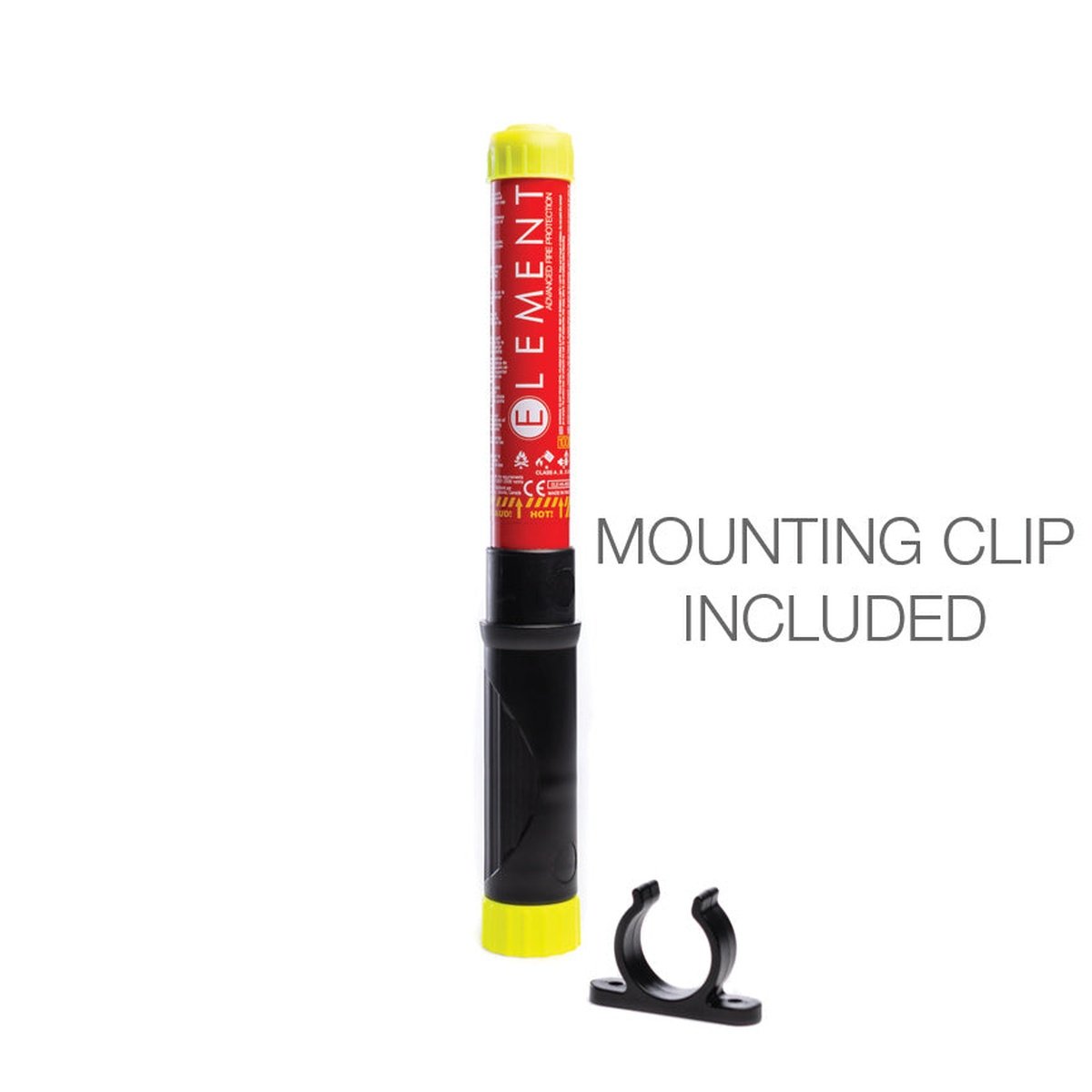
The Compact Revolution
The Element extinguisher represents a completely different approach to fire suppression. Rather than pressurized chemicals, it uses a potassium-based aerosol that chemically interrupts the fire's chain reaction.
At under 1 pound for the E50 and about 1.5 pounds for the E100, these are genuinely pocket-sized fire protection. They're maintenance-free, have no expiration date, and leave zero residue.
Extended Discharge Time
Element E50
50 sec
Discharge time
Element E100
100 sec
Discharge time
The discharge time is remarkable for devices this size. A traditional ABC extinguisher of comparable weight typically discharges in 8-10 seconds. This extended time gives you more opportunity to address a fire, particularly useful for incipient (starting) fires.
The Controversy: Real-World Effectiveness
Here's where we need to be honest: the Element has a mixed reputation in real-world scenarios.
What We Found
- Works well on: Small, incipient fires in enclosed spaces. Engine bay fires caught early. The gas is heavier than air and settles into compartments effectively.
- Struggles with: Established fires, fires with good airflow, larger flames. Several documented cases show the Element failing to suppress fires that a small ABC extinguisher handled.
The direct contact requirement is critical. Unlike a traditional extinguisher with 15-20 feet of range, the Element requires you to be quite close to the fire source. This limits its effectiveness on anything beyond small, contained fires.
Certification Reality
Element extinguishers are not UL Listed. They carry TUV and CE certifications (European standards), and are approved by organizations like the Porsche Club of America for track events.
For US insurance purposes, this matters. If you're relying on a fire extinguisher for insurance compliance, the Element may not qualify. Always check with your specific insurer.
However, for vehicle use — where the primary goal is protecting your car and passengers — the certifications are less critical than actual effectiveness.
Our Recommendation: The Dual Approach
Based on our testing and the documented real-world performance, here's our recommendation:
For Vehicles
- 1. Carry an Element E50 or E100 for immediate first response. It's small, clean, and perfect for catching small fires early.
- 2. Also carry a small ABC extinguisher (2.5 lb) as backup for more serious fires that the Element can't handle.
Use the Element first to avoid the mess of a dry chemical. If it doesn't work, you have the ABC as backup. This gives you the best of both worlds.